"On sober reflection, I find few reasons for publishing my Italian version of an obscure, neo-Gothic French version of a seventeenth-century Latin edition of a work written in Latin by a German monk toward the end of the fourteenth century."
Loved this quote (from Umberto Eco, The Name of the Rose)
Still struggling to keep this blog updated. Sorry for the random obscurity and brevity of this offering, but at least it shows I'm still alive.
Monday, March 27, 2006

Wednesday, February 08, 2006
Garry Williams on hostile history
I am inspired by Rosemary's post God loves maths. And arts. And science... to post some notes from a seminar given by Garry Williams on a Christian view of history or, more precisely on historiography, the writing of history. Williams argues that we are intrinsically historical as human beings. History is not a peripheral subject of interest to a few (out-of-date?) people, but something that shapes our understanding of the world we live in and our own identity. Consciously or not, we are all historians - we all have a view on/ an understanding of the past - and if we're not conscious of it, that probably indicates that we have by default adopted the version presented to us by our culture. As Christians, therefore, we must work to develop a Christian interpretation of history; if not we will unwittingly imbibe a non-Christian version, a version which will operate by principles that are profoundly hostile to the Lordship of Christ.
I hope to write more on history in future posts, but for now here are the said notes:
Hostile History
Garry Williams
22nd Evangelical Ministry Assembly 2005. Faith Facing Hostility.
Hostility towards Christ in the telling of history.
How we tell history is not neutral, but an arena of conflict
1) because of the extent of human depravity into all areas of human activity
history cannot properly be understood without the context of the progress of the gospel.
Pascal: “how fine it is to see with the eyes of faith, Darius and Cyrus, Alexander, the Romans, Pompei and Herod, working without knowing it for the glory of the gospel.”
history is Christian or anti-Christian history.
no facts outside of an interpretative framework
Van Til: “it is a Satanic falsehood to say that a fact is a fact to everybody alike.”
2) everybody is a historian
Despite anti-historical tendencies, “no culture can possibly continue for a moment without an articulated history.”
By telling history we define our world, and our place within the world. History is fundamental to our identity; telling history is an inalienable human activity.
all people are historians because all people are religious.
innate desire to worship, but channelled into history.
Responding to hostile history, engaging in Christian counter-history.
1) The Bible commits us to being historical creatures.
The Bible gives us an authoritative interpretation of history.
What about history beyond Acts, post-biblical history?
But the Bible embraces all of history – not in an ‘detailed end-times map’/rapture-index sense
“There is plenty of more mainstream evidence, is there not, for the reach of Scripture beyond the Acts of the Apostles in its discussion of human history. Think of the visions of Daniel, of that rock growing into a great mountain. Think of the mustard seed growing into a tree that shelters the birds, the nations, that come to nest in its branches. Think of the lump being leavened as the yeast leavens the whole. Think even of the Great Commission – making disciples of all nations. All of these are Biblical pictures of post-biblical history.”
“How we view the last 2000 years is determined by the teaching of Scripture.”
2) The Lord Jesus Christ claims total Lorship over all the earth
“The Christian religion must become the universal religion because Jesus is the universal Lord.”
3) If we don’t, we will by default pick up a non-Christian history of the world
In practice
1) self-scrutiny. What kind of history have we imbibed?
2) forming our own historical understanding. Take small steps.
3) teach historically
The full seminar can be bought from the Proclamation trust here.
You can read about Garry Williams, a lecturer at Oak Hill theological college, here.
PS. I also found the following article by Garry Williams very helpful:
Cross Purpose: replying to Steve Chalke on penal substitution.
I hope to write more on history in future posts, but for now here are the said notes:
Hostile History
Garry Williams
22nd Evangelical Ministry Assembly 2005. Faith Facing Hostility.
Hostility towards Christ in the telling of history.
How we tell history is not neutral, but an arena of conflict
1) because of the extent of human depravity into all areas of human activity
history cannot properly be understood without the context of the progress of the gospel.
Pascal: “how fine it is to see with the eyes of faith, Darius and Cyrus, Alexander, the Romans, Pompei and Herod, working without knowing it for the glory of the gospel.”
history is Christian or anti-Christian history.
no facts outside of an interpretative framework
Van Til: “it is a Satanic falsehood to say that a fact is a fact to everybody alike.”
2) everybody is a historian
Despite anti-historical tendencies, “no culture can possibly continue for a moment without an articulated history.”
By telling history we define our world, and our place within the world. History is fundamental to our identity; telling history is an inalienable human activity.
all people are historians because all people are religious.
innate desire to worship, but channelled into history.
Responding to hostile history, engaging in Christian counter-history.
1) The Bible commits us to being historical creatures.
The Bible gives us an authoritative interpretation of history.
What about history beyond Acts, post-biblical history?
But the Bible embraces all of history – not in an ‘detailed end-times map’/rapture-index sense
“There is plenty of more mainstream evidence, is there not, for the reach of Scripture beyond the Acts of the Apostles in its discussion of human history. Think of the visions of Daniel, of that rock growing into a great mountain. Think of the mustard seed growing into a tree that shelters the birds, the nations, that come to nest in its branches. Think of the lump being leavened as the yeast leavens the whole. Think even of the Great Commission – making disciples of all nations. All of these are Biblical pictures of post-biblical history.”
“How we view the last 2000 years is determined by the teaching of Scripture.”
2) The Lord Jesus Christ claims total Lorship over all the earth
“The Christian religion must become the universal religion because Jesus is the universal Lord.”
3) If we don’t, we will by default pick up a non-Christian history of the world
In practice
1) self-scrutiny. What kind of history have we imbibed?
2) forming our own historical understanding. Take small steps.
3) teach historically
The full seminar can be bought from the Proclamation trust here.
You can read about Garry Williams, a lecturer at Oak Hill theological college, here.
PS. I also found the following article by Garry Williams very helpful:
Cross Purpose: replying to Steve Chalke on penal substitution.
Monday, January 30, 2006
A House Sparrow (Passer Domesticus) in our garden
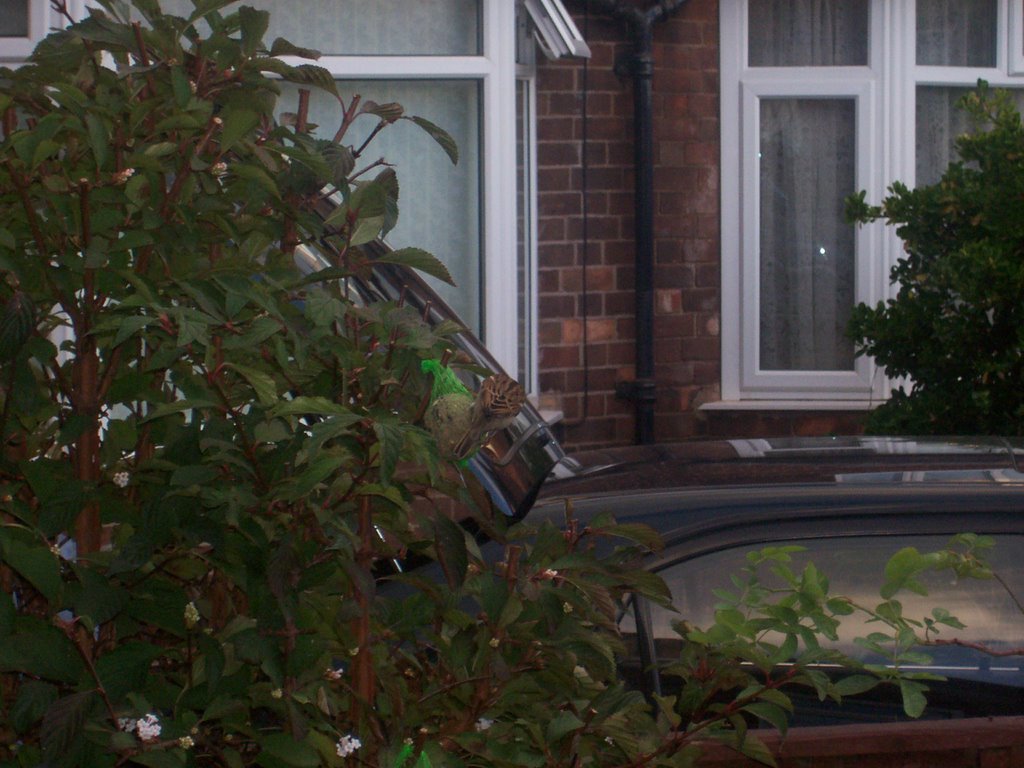
I love birds and watching them, but sadly we have probably the worst garden in Britain for birds. It is small and backs onto a small industrial estate in which there is often an ice cream warehouse and, sometimes, invisibly, a Ferrari. A reasonable species total for a typical suburban garden may range, I would say, between 20 and 30, but in 2.5 years, I have seen a mere 6 kinds of birds in our garden: a few house sparrows, a robin (maybe a couple of times), a wren (once), a pair of great tits (once), some long-tailed tits (once) and (very incredibly) a grey wagtail!!! - the latter when we had no grass on our lawn. We could have joined in the RSPB's Garden Birdwatch but I haven't seen a single bird in the back garden for months (since October 28th to be precise!)
The front garden is even smaller, and has only recently had a few birds when we have put some seed balls out. The photo shows a brave house sparrow in our bush (the house that is visible is a neighbour's) . And to our great joy, two blue tits joined in for a few minutes about a week ago!!
"Birds in our street" would probably be up around the 25-30 mark. There have been mistle thrushes occasionally, and even a linnet and a willow tit have made appearances! Slightly further afield, sparrowhawks can be seen every now and then zooming across the estate and, most special of all, I found a solitary waxwing last winter in a small tree within shouting distance of our house. Only the fourth time I've ever seen a waxwing.
Sunday, January 15, 2006
I haven't died yet.
I am discovering that having a full-time job which involves staring at a computer screen all day, plus a baby and plenty of other responsibilities is not conducive to keeping a regular blog. If I knew that no-one read my blog then I wouldn't feel so bad, but now that my friends Mark and Dan have publicised its existence to the world, I suddenly feel a huge sense of responsibility!
Anyway, warm greetings to the both of you. And thanks for your comments! I have seriously loved reading both your blogs and I may post some comments about them on another occasion...
For now, my not-too-serious post title (intended to convey the continuing survival of this blog) reminds me that death is, in fact, an extremely serious matter. Let me briefly quote from John Piper some words that first impacted me deeply about 4 years ago:
Urging that preaching should be characterised by great seriousness and great joy, he writes,
"Direct your mind often to the contemplation of death. It is absolutely inevitable if the Lord tarries, and it is utterly momentous. Not to think on its implications for life and preaching is incredibly naive. [Jonathan] Edwards was the man he was - with depth and power (and eleven believing children!) - because of resolutions like these that he made as a young man:
"9. Resolved, To think much, on all occasions, of my dying, and of the common circumstances which attend death.
"55. Resolved, To endeavor to my utmost, so to act, as I can think I should do, if I had already seen the happiness of heaven and torments of hell.
"Every funeral I preach is a deeply sobering experience for me because I sit there before my message and imagine myself or my wife or sons or daughters in that coffin. Death and sickness have an amazing way of blowing the haze of triviality out of life and replacing it with the wisdom of gravity and gladness in the hope of resurrection joy."
[Piper, J. (2004, rev. ed.) The Supremacy of God in Preaching (Grand Rapids, MI: Baker Books) pp.64-65
Or compare these words of Matthew Henry (in his Commentary), on Zechariah 1:5
"Ministers are dying men, and live not for ever in this world. They are to look upon themselves as such, and to preach accordingly, as those that must be silenced shortly, and know not which sermon may be the last... Oh that this weighty consideration had its due weight given it, that we are dying ministers dealing with dying people about the concerns of immortal souls and an awful eternity, which both they and we are standing upon the brink of!"
And these words are not just for preachers. If the trivialities of life have dulled your mind and blinded your eyes, wake up and remember that one day you will die and stand before God. If Christ does not return first "at an hour when you do not expect him." "Therefore keep watch" (Mat 24:44, 42)
Anyway, warm greetings to the both of you. And thanks for your comments! I have seriously loved reading both your blogs and I may post some comments about them on another occasion...
For now, my not-too-serious post title (intended to convey the continuing survival of this blog) reminds me that death is, in fact, an extremely serious matter. Let me briefly quote from John Piper some words that first impacted me deeply about 4 years ago:
Urging that preaching should be characterised by great seriousness and great joy, he writes,
"Direct your mind often to the contemplation of death. It is absolutely inevitable if the Lord tarries, and it is utterly momentous. Not to think on its implications for life and preaching is incredibly naive. [Jonathan] Edwards was the man he was - with depth and power (and eleven believing children!) - because of resolutions like these that he made as a young man:
"9. Resolved, To think much, on all occasions, of my dying, and of the common circumstances which attend death.
"55. Resolved, To endeavor to my utmost, so to act, as I can think I should do, if I had already seen the happiness of heaven and torments of hell.
"Every funeral I preach is a deeply sobering experience for me because I sit there before my message and imagine myself or my wife or sons or daughters in that coffin. Death and sickness have an amazing way of blowing the haze of triviality out of life and replacing it with the wisdom of gravity and gladness in the hope of resurrection joy."
[Piper, J. (2004, rev. ed.) The Supremacy of God in Preaching (Grand Rapids, MI: Baker Books) pp.64-65
Or compare these words of Matthew Henry (in his Commentary), on Zechariah 1:5
"Ministers are dying men, and live not for ever in this world. They are to look upon themselves as such, and to preach accordingly, as those that must be silenced shortly, and know not which sermon may be the last... Oh that this weighty consideration had its due weight given it, that we are dying ministers dealing with dying people about the concerns of immortal souls and an awful eternity, which both they and we are standing upon the brink of!"
And these words are not just for preachers. If the trivialities of life have dulled your mind and blinded your eyes, wake up and remember that one day you will die and stand before God. If Christ does not return first "at an hour when you do not expect him." "Therefore keep watch" (Mat 24:44, 42)
Monday, December 12, 2005
Brief reflections on blogging and reading
One of the things that I learnt from John Frame, in The Doctrine of the Knowledge of God (DKG) (see post: some books) is that ontology precedes epistemology. That is, what we know precedes how we know. We know things - many things, before we get round to reflecting on our process of knowing. One might think, Frame argues, that we should be clear about the methods that we do use or should use in acquiring knowledge before we embark on knowing. After all, how can we be sure we're not using faulty methods if we don't set them out clearly beforehand? The knowledge we have may be seriously skewed since we may be using the wrong methods of getting it? So LET'S GET OUR METHODS STRAIGHT FIRST!!!!!!! (note the increasing fervour) Wrong - contends Frame - "Contrary to our intellectualist prejudices, the practice of something generally precedes its definition" We know many things before we rationalise about the process of knowing.
Well, the point of this post is not to indulge in lengthy philosophical reflections. I have appended a paragaph from DKG if you're interested. Rather, Frame's point was brought to mind as I reflected a little over this thing called blogging which I have recently embarked upon. But rather than reflect excessively at this stage over the nature and purpose of blogging, perhaps it is better to go straight into blogging, do some, and reflect as I go along.
Which leads me, rather haphazardly, to me saying that at this stage I have no great scheme, or plan of 18 themes that I wish to develop in this blog. I therefore at this stage throw out some random reflections, and see where they end up.
I hope at some stage to write some posts on the books which I have said have been influential to me at different times of my life, and some of the lessons I have learnt from them. Books are incredibly important, for many reasons, but two thoughts are brought to mind at this point:
1) John Piper has a chapter in Brothers, We Are not Professionals entitled "Brothers, Fight for Your Life" What is it about? Books. He begins:
"I agree with Martyn Lloyd-Jones that the fight to find time to read is a fight for one's life. 'Let your wife or anyone else take messages for you, and inform the people who are telephoning that you are not available. One literally has to fight for one's life in this sense.'"
Why so? Because of the sheer, desperate need to feed our own souls. Piper is writing particularly for pastors, who face the danger of being drained, becoming dry, as they prepare messages, give, serve, serve, serve:
"For your own soul and for the life of your church, fight for time to feed your soul with rich reading. Almost all the forces in our culture are trivializing. If you want to stay alive to what is great and glorious and beautiful and eternal, you will have to fight for time to look through the eyes of others who were in touch with God."
This is not just for pastors.
2) Secondly, I am reminded by some comments by Don Carson, in his brief reflection on 2 Timothy 3 (For the love of God volume 1) In the light of the sin and dangers of the last days (NB = which "range from Christ's ascension to his return) (vv.1-7), how should we live?
"First, we must resolve to follow the best mentors (3:10-11). These are the people whose lives reflect the Gospel, and who have been tested by hardship and protected by God. In a world of many pop idols, not least in the field of religion, we must become intentional about choosing the best mentors, or by default we shall probably choose poor ones."
Carson has more to say on this theme in Basics for Believers, chapter 4, "Emulate Worthy Christian Leaders".
It may not be easy to find mature Christians to act as examples and mentors to us. (cf. post by Dan Bowen and comments by Mark Heath here) And books are in many ways poor substitutes. But the books we read can have a profound influence on our thinking and our living. And so we must choose carefully who to read; to choose carefully which books and authors we should allow to mentor us.
It is good to read widely, to read a variety, even to read books that are profoundly unhelpful (with caveats - I hope to post some thoughts on this at a later date). But we must select carefully those books which will mentor us, which will quench our thirst when we are dry, which will refresh us when we are drained, which will challenge us when we are complacent. And of course, it is to God's Word we must turn to first and most frequently. But we must also select with wisdom those things we read that will expound and preach and apply and wield God's Word to us.
END OF POST
As promised, I append a longer quote from John Frame:
"One could argue that the doctrine of the knowledge of God ought to be a student's first introduction to systematic theology. After all, it seems that one must know what knowing is before one goes about the business of knowing specific things. One must know what theology is before one can do theology. Right? Well, yes and no. On the one hand, there is certainly much virtue in the idea of discussing epistemology toward the beginning of a student's theological course of study, since it does provide him with concepts and methods that will enrich the rest of his study. On the other hand, the lack of philosophical, linguistic, and catechetical background of many seminary students makes me wonder if first-year students are ready to tackle an area of study as difficult as this can be. And more seriously, there is a sense in which students are not ready to define "theology" until they have done it, just as they are not ready to define "knowledge" until they have done some knowing. Contrary to our intellectualist prejudices, the practice of something generally precedes its definition. (People were writing poetry and thinking logically long before Aristotle defined poetry and formulated a logic.) Can you do theology without knowing what theology is? Of course, just as you can tell time without having a definition of "time," just as you can walk or eat or breathe without being able to give precise definitions of those activities. And sometimes we must do something before we can define it. It is scarcely conceivable that anyone could define "seeing" without ever having seen anything. And if a blind man were able, through reading in braille dictionaries, to define sight, imagine how much deeper his understanding of it would be after his sight were restored. A student is not ready, in my view, to appreciate definitions of "theology" or of the "knowledge of God" unless he has already done some ` theology and unless he already knows God!"
Well, the point of this post is not to indulge in lengthy philosophical reflections. I have appended a paragaph from DKG if you're interested. Rather, Frame's point was brought to mind as I reflected a little over this thing called blogging which I have recently embarked upon. But rather than reflect excessively at this stage over the nature and purpose of blogging, perhaps it is better to go straight into blogging, do some, and reflect as I go along.
Which leads me, rather haphazardly, to me saying that at this stage I have no great scheme, or plan of 18 themes that I wish to develop in this blog. I therefore at this stage throw out some random reflections, and see where they end up.
I hope at some stage to write some posts on the books which I have said have been influential to me at different times of my life, and some of the lessons I have learnt from them. Books are incredibly important, for many reasons, but two thoughts are brought to mind at this point:
1) John Piper has a chapter in Brothers, We Are not Professionals entitled "Brothers, Fight for Your Life" What is it about? Books. He begins:
"I agree with Martyn Lloyd-Jones that the fight to find time to read is a fight for one's life. 'Let your wife or anyone else take messages for you, and inform the people who are telephoning that you are not available. One literally has to fight for one's life in this sense.'"
Why so? Because of the sheer, desperate need to feed our own souls. Piper is writing particularly for pastors, who face the danger of being drained, becoming dry, as they prepare messages, give, serve, serve, serve:
"For your own soul and for the life of your church, fight for time to feed your soul with rich reading. Almost all the forces in our culture are trivializing. If you want to stay alive to what is great and glorious and beautiful and eternal, you will have to fight for time to look through the eyes of others who were in touch with God."
This is not just for pastors.
2) Secondly, I am reminded by some comments by Don Carson, in his brief reflection on 2 Timothy 3 (For the love of God volume 1) In the light of the sin and dangers of the last days (NB = which "range from Christ's ascension to his return) (vv.1-7), how should we live?
"First, we must resolve to follow the best mentors (3:10-11). These are the people whose lives reflect the Gospel, and who have been tested by hardship and protected by God. In a world of many pop idols, not least in the field of religion, we must become intentional about choosing the best mentors, or by default we shall probably choose poor ones."
Carson has more to say on this theme in Basics for Believers, chapter 4, "Emulate Worthy Christian Leaders".
It may not be easy to find mature Christians to act as examples and mentors to us. (cf. post by Dan Bowen and comments by Mark Heath here) And books are in many ways poor substitutes. But the books we read can have a profound influence on our thinking and our living. And so we must choose carefully who to read; to choose carefully which books and authors we should allow to mentor us.
It is good to read widely, to read a variety, even to read books that are profoundly unhelpful (with caveats - I hope to post some thoughts on this at a later date). But we must select carefully those books which will mentor us, which will quench our thirst when we are dry, which will refresh us when we are drained, which will challenge us when we are complacent. And of course, it is to God's Word we must turn to first and most frequently. But we must also select with wisdom those things we read that will expound and preach and apply and wield God's Word to us.
END OF POST
As promised, I append a longer quote from John Frame:
"One could argue that the doctrine of the knowledge of God ought to be a student's first introduction to systematic theology. After all, it seems that one must know what knowing is before one goes about the business of knowing specific things. One must know what theology is before one can do theology. Right? Well, yes and no. On the one hand, there is certainly much virtue in the idea of discussing epistemology toward the beginning of a student's theological course of study, since it does provide him with concepts and methods that will enrich the rest of his study. On the other hand, the lack of philosophical, linguistic, and catechetical background of many seminary students makes me wonder if first-year students are ready to tackle an area of study as difficult as this can be. And more seriously, there is a sense in which students are not ready to define "theology" until they have done it, just as they are not ready to define "knowledge" until they have done some knowing. Contrary to our intellectualist prejudices, the practice of something generally precedes its definition. (People were writing poetry and thinking logically long before Aristotle defined poetry and formulated a logic.) Can you do theology without knowing what theology is? Of course, just as you can tell time without having a definition of "time," just as you can walk or eat or breathe without being able to give precise definitions of those activities. And sometimes we must do something before we can define it. It is scarcely conceivable that anyone could define "seeing" without ever having seen anything. And if a blind man were able, through reading in braille dictionaries, to define sight, imagine how much deeper his understanding of it would be after his sight were restored. A student is not ready, in my view, to appreciate definitions of "theology" or of the "knowledge of God" unless he has already done some ` theology and unless he already knows God!"
Saturday, December 10, 2005
Some books
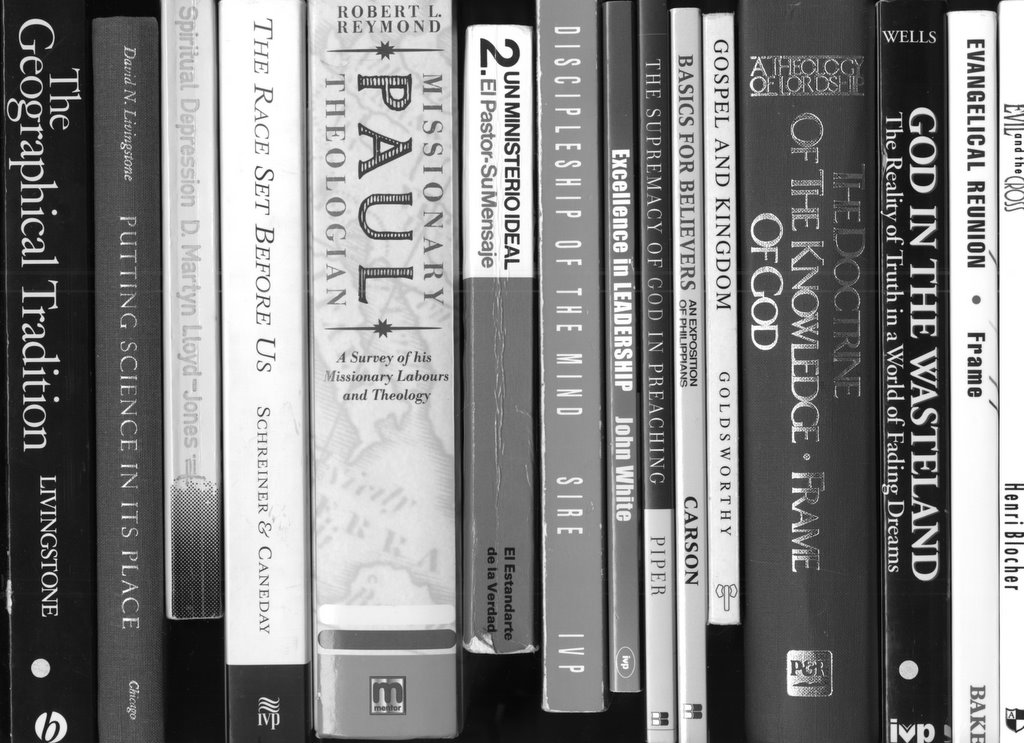
I went through my bookshelves last night to locate some of the books which have been particularly influential at various times in my life. Here they are!
Sunday, December 04, 2005
Taking the plunge, but for what purpose?
I hardly know at this stage where this blog is going to go. I feel it must have some purpose, something to contribute, yet at this stage I am not clear what. I suspect that for a few months, it will consist of rather sporadic, somewhat random entries, until I find my feet and have a clearer sense of direction. In that respect it is not unlike beginning to submerge oneself in a new literature, dipping one's toe into a new realm of enquiry, not quite sure where one is going to be taken.
At this stage, my idea is to use this blog to comment on things I have read; readings that have stimulated my mind in all kinds of directions. I shall be attempting to think and write as a Christian, but not only on areas which would be called 'religious'. Better put, since all of life is religious, :) I will be seeking to bring a Christian mind to bear on everything I possibly can!!
My particular areas of interests lie in things like geography and history, in theology and Biblical interpretation, in birdwatching and sport, in Spain, and more besides.
It is a rather strange to think that these random thoughts will be posted on a blog that could be read by anyone, or, more likely, no-one! Doubtless they will be lost in the virtual ether! But I am (potentially) publishing my thoughts to the world! What a scary thought. And yet, my innermost thoughts and feelings are already known. "Nothing in all creation is hidden from God's sight. Everything is uncovered and laid bare before the eyes of him to whom we must give account." (Hebrews 4:13)
At this stage, my idea is to use this blog to comment on things I have read; readings that have stimulated my mind in all kinds of directions. I shall be attempting to think and write as a Christian, but not only on areas which would be called 'religious'. Better put, since all of life is religious, :) I will be seeking to bring a Christian mind to bear on everything I possibly can!!
My particular areas of interests lie in things like geography and history, in theology and Biblical interpretation, in birdwatching and sport, in Spain, and more besides.
It is a rather strange to think that these random thoughts will be posted on a blog that could be read by anyone, or, more likely, no-one! Doubtless they will be lost in the virtual ether! But I am (potentially) publishing my thoughts to the world! What a scary thought. And yet, my innermost thoughts and feelings are already known. "Nothing in all creation is hidden from God's sight. Everything is uncovered and laid bare before the eyes of him to whom we must give account." (Hebrews 4:13)
Sunday, October 09, 2005
Posts by topic
THEOLOGY - BOOKS
Some books
A note from Iain Murray on recommended reading
The moral goodness of business (Thoughts on reading Business to the Glory of God by Wayne Grudem)
The moral goodness of business 2 (Follow-up to questions from earlier review)
Book influences (Introduction)
Books that have influenced me Part 1
HISTORY
Was Evangelicalism created by the Enlightenment?
Garry Williams on Hostile History
ON BLOGGING
Brief reflections on blogging and reading
Taking the plunge, but for what purpose? (my first proper post, as I enter the blogosphere)
MISCELLANEOUS REFLECTIONS AND QUOTES
Unanswered Questions (on the existence of nature and the glory of God)
Two Things I Find Beautiful (arctic terns and Christian hospitality)
Embrace Hardship (two quotes)
Pride
Random Quote
I haven't died yet (living in the light of death)
FAMILY
Happy birthday, Timothy (first birthday)
Never too early ("reading" a theological book)
BIRDS - PHOTOS
A house sparrow in our garden (2)
Turnstones on shore
Turnstone feeding on fiddler crab
Arctic terns in Helsinki
A fearless nuthatch
A House Sparrow (Passer Domesticus) in our garden
BIRDS - OTHER
Arenaria interpres (explanation of new blog name, which is the latin name for the turnstone)
Unanswered Questions (musings on the significance of the black-tailed godwit)
Two Things I Find Beautiful (arctic terns and Christian hospitality)
Some books
A note from Iain Murray on recommended reading
The moral goodness of business (Thoughts on reading Business to the Glory of God by Wayne Grudem)
The moral goodness of business 2 (Follow-up to questions from earlier review)
Book influences (Introduction)
Books that have influenced me Part 1
HISTORY
Was Evangelicalism created by the Enlightenment?
Garry Williams on Hostile History
ON BLOGGING
Brief reflections on blogging and reading
Taking the plunge, but for what purpose? (my first proper post, as I enter the blogosphere)
MISCELLANEOUS REFLECTIONS AND QUOTES
Unanswered Questions (on the existence of nature and the glory of God)
Two Things I Find Beautiful (arctic terns and Christian hospitality)
Embrace Hardship (two quotes)
Pride
Random Quote
I haven't died yet (living in the light of death)
FAMILY
Happy birthday, Timothy (first birthday)
Never too early ("reading" a theological book)
BIRDS - PHOTOS
A house sparrow in our garden (2)
Turnstones on shore
Turnstone feeding on fiddler crab
Arctic terns in Helsinki
A fearless nuthatch
A House Sparrow (Passer Domesticus) in our garden
BIRDS - OTHER
Arenaria interpres (explanation of new blog name, which is the latin name for the turnstone)
Unanswered Questions (musings on the significance of the black-tailed godwit)
Two Things I Find Beautiful (arctic terns and Christian hospitality)
Subscribe to:
Posts (Atom)